Portable Fire Extinguishers: Their Role in First Attack Firefighting
The Right Equipment, the Right Knowledge and the Right Response
Portable fire extinguishers are one of the most recognisable forms of fire protection equipment found in Australian workplaces and buildings.
When correctly selected, located, maintained and—most importantly—used by someone who understands their limitations, a portable fire extinguisher can provide an effective means of first attack firefighting.
A small fire identified in its early stages may be able to be controlled or extinguished before it develops into a much larger emergency. However, attempting to fight a fire is never more important than personal safety.
At VERST Fire Services, we believe effective fire protection involves more than simply installing and maintaining equipment. Building occupants and employees should also understand what fire protection equipment is provided, how it operates and what actions they should take during an emergency.
What Is First Attack Firefighting?
First attack firefighting refers to the initial response to a small or developing fire using equipment such as portable fire extinguishers, fire blankets or fire hose reels.
The objective is to control or extinguish a fire while it remains in its early stages and only where it is safe to do so.
Portable fire extinguishers are not intended to replace the response of emergency services, nor should occupants place themselves at unnecessary risk attempting to save property.
Before attempting to use an extinguisher, a person should consider:
- Has the alarm been raised?
- Have other occupants been warned?
- Is the fire small and contained?
- Do I have the correct extinguisher for the type of fire?
- Do I know how to operate the extinguisher?
- Do I have a clear and safe path of escape behind me?
- Is it safe for me to attempt to extinguish the fire?
If there is any doubt, the safest response is to evacuate the area, close doors where practicable and safe to do so, and allow emergency services to respond.
Life safety must always take priority over property protection.
Not Every Fire Extinguisher Is the Same
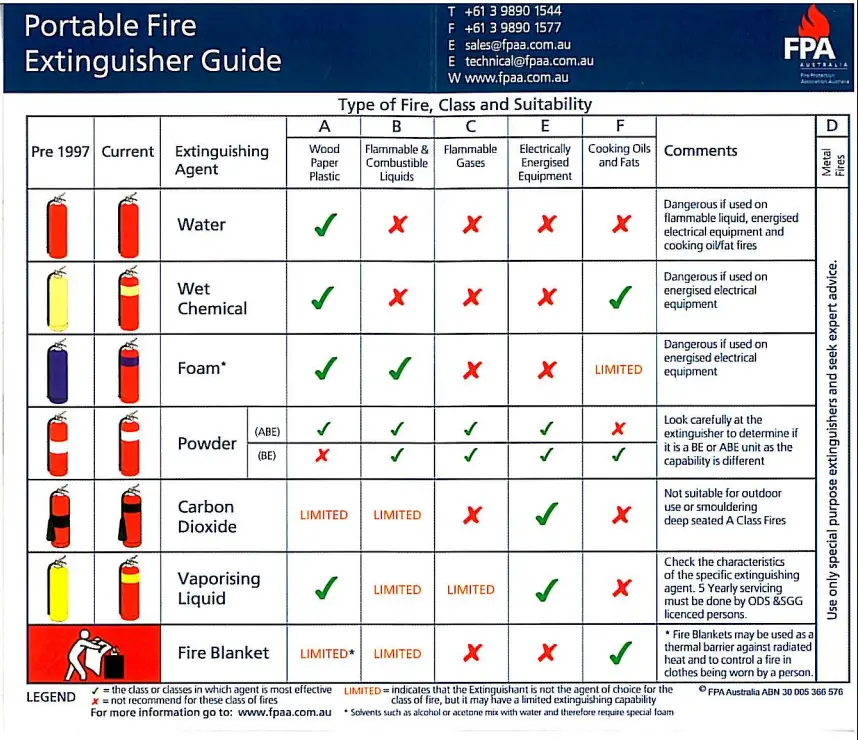
One of the most important aspects of first attack firefighting is understanding that different types of fires require different extinguishing agents.
Portable fire extinguishers are selected according to the particular fire risks within an area.
Common extinguisher types include:
Dry Chemical Powder (DCP)
Dry Chemical Powder extinguishers are commonly found in commercial and industrial environments and can be suitable for a range of fire risks depending on their classification.
While extremely versatile, the powder can cause significant contamination and damage to sensitive electrical and electronic equipment.
Carbon Dioxide (CO₂)
CO₂ extinguishers are commonly provided around electrical equipment because the extinguishing agent does not leave a residue.
However, CO₂ has limitations and requires particular care when used in confined or poorly ventilated spaces.
Air-Water Extinguishers
Water extinguishers can be effective against certain fires involving ordinary combustible materials such as paper, cardboard and timber.
Water must not be used where it creates an electrical hazard or on fires involving cooking oils and fats.
Foam Extinguishers
Foam extinguishers may be suitable for particular combustible material and flammable-liquid risks, depending on the extinguisher’s rating and application.
Wet Chemical Extinguishers
Wet Chemical extinguishers are commonly associated with commercial cooking environments and are specifically designed for fires involving cooking oils and fats.
Selecting the wrong extinguisher can be ineffective and, in some circumstances, can make a fire considerably more dangerous.
This is one of the reasons practical Fire Extinguisher Usage Training is so valuable.
Australian Standards and Portable Fire Extinguishers
Portable fire extinguishers form part of the fire safety provisions within many Australian buildings and are subject to requirements relating to their selection, installation and ongoing maintenance.
AS 2444 – Selection and Location
AS 2444 provides requirements and guidance relating to the selection and location of portable fire extinguishers and fire blankets.
Correct extinguisher selection considers factors such as:
- The type of fire risk present
- The size and nature of the area being protected
- Travel distances to extinguishers
- Accessibility
- Visibility and signage
- Potential hazards associated with the extinguishing agent
Simply having an extinguisher somewhere within a building does not necessarily mean appropriate protection has been provided.
The extinguisher needs to be suitable for the particular risk and positioned so that it can be readily identified and accessed when required.
AS 1851-2012 – Routine Service of Fire Protection Systems and Equipment
Once installed, portable fire extinguishers require ongoing inspection, testing and maintenance.
AS 1851-2012 establishes routine service requirements for fire protection systems and equipment, including portable fire extinguishers.
Routine servicing helps identify issues such as:
- Missing or relocated extinguishers
- Incorrect extinguisher types
- Damage or corrosion
- Loss of pressure
- Missing or damaged safety pins and tamper seals
- Obstructed access
- Incorrect mounting
- Missing or damaged location signage
- Extinguishers that have been discharged or partially discharged
- Equipment that has reached applicable testing or replacement requirements
Routine maintenance is essential because an extinguisher that appears perfectly serviceable from a distance may not necessarily operate correctly when required.
NCC, Essential Safety Measures and Victorian Building Regulations
Depending on the building and its approval requirements, portable fire extinguishers may form part of the building’s required fire safety systems and Essential Safety Measures (ESMs).
The National Construction Code (NCC), together with applicable Victorian building legislation and regulations, establishes requirements relating to fire safety measures within buildings.
Where portable fire extinguishers form part of a building’s Essential Safety Measures, building owners and responsible parties need to ensure that the equipment is appropriately maintained and that required records are retained.
This can form part of the broader Essential Safety Measures maintenance and reporting obligations applying to a building.
Importantly, compliance should not be viewed simply as having a service technician attach a tag to an extinguisher.
Effective fire safety requires the correct equipment, appropriate maintenance and people who understand what to do during an emergency.
Why Fire Extinguisher Training Matters
Most people recognise a fire extinguisher.
Far fewer have actually operated one.
During a real fire emergency, stress, smoke, noise and uncertainty can make even a relatively simple task considerably more difficult.
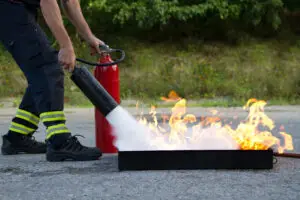
Practical Fire Extinguisher Usage Training gives participants an opportunity to understand the equipment before they are faced with an actual emergency.
Effective training should help participants understand:
- Different classes and types of fire
- How to identify the appropriate extinguisher
- The limitations of portable fire extinguishers
- How to safely approach a small fire
- How to operate an extinguisher correctly
- The importance of maintaining a safe escape route
- When first attack firefighting should not be attempted
- When to withdraw and evacuate
Training can turn an unfamiliar piece of emergency equipment into something employees understand and can make an informed decision about using.
Just as importantly, good training teaches people when not to use it.
First Attack Firefighting Should Never Delay Evacuation
One of the most important messages surrounding portable fire extinguishers is that occupants should never become so focused on extinguishing a fire that they compromise their own safety or the safety of others.
A fire can develop extremely quickly.
Conditions that initially appear manageable can deteriorate due to:
- Rapid fire growth
- Smoke accumulation
- Toxic combustion products
- Heat
- Reduced visibility
- Unexpected involvement of combustible materials
- Changes in available escape routes
If an extinguisher does not immediately have the desired effect, or conditions begin to deteriorate, the person should withdraw and evacuate.
Portable fire extinguishers are designed for first attack firefighting—not prolonged firefighting.
Fire Safety Is About More Than Equipment
Fire protection systems and equipment are an essential part of building safety, but equipment alone cannot provide an effective emergency response.
People are an equally important part of the equation.
Building occupants need to understand:
- How to raise the alarm
- How to respond to an emergency
- Where emergency exits are located
- Their responsibilities during an evacuation
- How to assist with an orderly evacuation
- When first attack firefighting may be appropriate
- When evacuation must take priority
For businesses, this is where fire protection maintenance, emergency planning and training should work together rather than being treated as completely separate activities.
Victorian Emergency Response Safety and Training
The VERST in VERST Fire Services stands for Victorian Emergency Response Safety and Training.
This reflects an important part of what we do.
In addition to inspecting, testing and maintaining fire protection systems and Essential Safety Measures, VERST Fire Services can provide practical emergency response and fire safety training, including:
- Fire Warden Training
- Fire Extinguisher Usage Training
- Emergency Evacuation Training
- Emergency response and workplace fire safety training
Our objective is not simply to help businesses maintain compliant fire protection equipment.
We want the people working within those buildings to understand their fire safety systems and have the knowledge and confidence to respond appropriately should an emergency occur.
How VERST Fire Services Can Help?
At VERST Fire Services, we provide inspection, testing and maintenance of portable fire equipment and Essential Safety Measures throughout Victoria.
We can also work with businesses to provide Fire Extinguisher Usage Training, Fire Warden Training and Emergency Evacuation Training, helping bridge the gap between having fire protection equipment installed and knowing what to do when an emergency actually occurs.
A properly selected and maintained portable fire extinguisher can be an extremely effective first attack firefighting tool.
But the best piece of fire protection equipment is only truly effective when it is maintained, accessible and understood by the people who may need to use it.
Keeping your building protected, compliant and operational.