Essential Safety Measures (ESM) in Victorian Buildings: A Guide for Owners
Introduction
Essential Safety Measures (ESMs) are the specialised safety features and services within a building designed to protect occupants and property in the event of an emergency, particularly fire. Once construction is complete, the maintenance of these measures becomes a critical ongoing responsibility for the building owner. Proper upkeep ensures that vital systems—ranging from detection to suppression—remain functional and perform at their required operational level throughout the entire life of the building.
What are ESMs?
An ESM is defined by Victorian Building Regulations as specific safety items that must be inspected and maintained regularly. Common examples found in commercial properties include:
- Fire Suppression: Sprinkler systems, fire extinguishers, and fire hydrant systems.
- Egress & Signage: Exit doors, exit signs, and designated paths of travel to exits.
- Detection & Warning: Smoke alarms, fire detectors, and early warning systems.
- Infrastructure: Emergency lighting, emergency power supplies, fire curtains, and smoke control systems.
- Ventilation: Mechanical ventilation and air conditioning systems designed for fire safety.
Core Owner Responsibilities
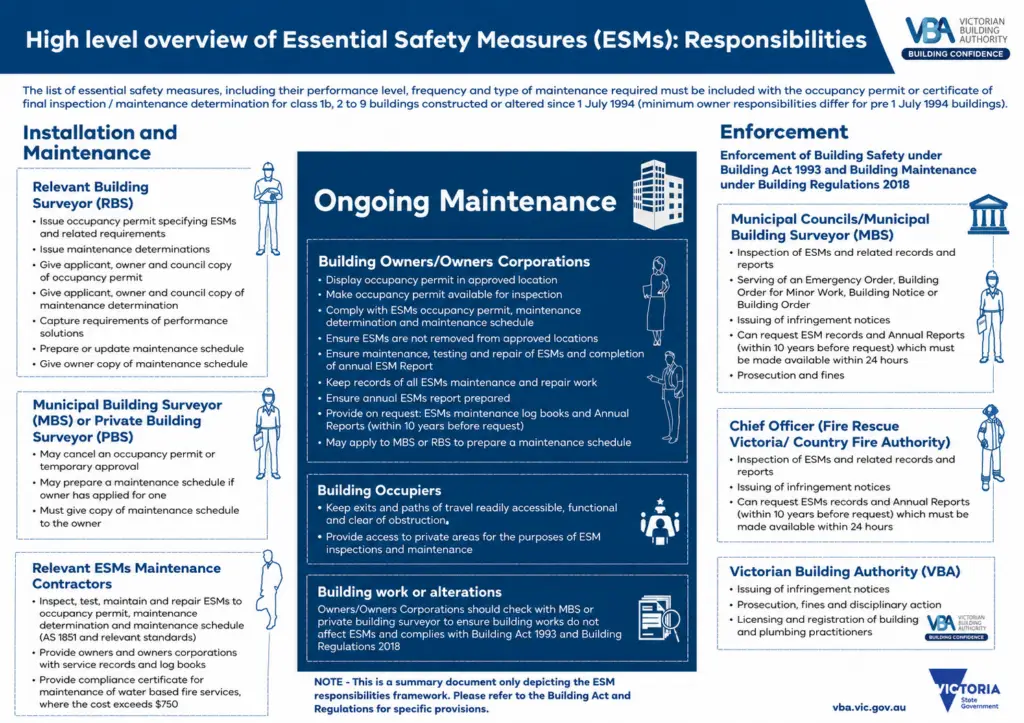
The building owner holds the ultimate legal obligation to ensure that every ESM is maintained so it operates satisfactorily. Key responsibilities include:
- System Maintenance: Ensuring that safety equipment is fulfilling its intended purpose through regular testing.
- Record Keeping: Owners must maintain detailed records of maintenance checks, service reports, and any repair work carried out. These records must be kept for 10 years and made available to the municipal building surveyor or fire brigade chief officer within 24 hours of notification.
- Contractor Management: While owners may engage specialist maintenance contractors to perform inspections and testing, the owner is responsible for providing these contractors with necessary documentation, such as Occupancy Permits and Maintenance Determinations.
- Competent Persons: Maintenance and testing must be performed by competent individuals who have the necessary training, qualifications, and experience, as defined in AS 1851-2012.
Compliance Differences
The regulatory requirements vary depending on the age of the building and when major works were performed:
Buildings Constructed or Altered Since 1 July 1994
For these properties, the relevant building surveyor issues an Occupancy Permit or Certificate of Final Inspection. These documents explicitly list the required ESMs, the performance levels they must achieve, and the frequency of maintenance required. Owners of these buildings must display current Occupancy Permits in a prominent location and prepare an Annual Essential Safety Measures Report (AESMR) using the approved form.
Buildings Constructed Prior to 1 July 1994
Owners of older buildings are still legally responsible for ensuring that all safety measures are maintained and functional. Modern regulations now require these owners to also prepare an AESMR and keep comprehensive records of upkeep to prove compliance to authorities if inspected.
Key Compliance Documents: MD and MS
Compliance is guided by two primary “blueprints” issued by building surveyors:
- Maintenance Determination (MD): This document is issued when ESMs are provided or altered, typically for work that does not require a new Occupancy Permit. It is a critical mechanism to capture new or updated maintenance requirements.
- Maintenance Schedule (MS): This is a consolidation document that lists all ESMs and their maintenance requirements for a building. It is intended to serve as a single, central point of reference for owners and contractors to ensure no safety measure is overlooked.
The Annual Essential Safety Measures Report (AESMR)
The building owner is legally responsible for ensuring that an AESMR is prepared annually within 28 days before the anniversary of the building’s first occupancy permit or maintenance determination. This prescribed statutory report confirms that all ESMs have been maintained and are performing satisfactorily. To prepare the AESMR, owners must compile several key documents:
- Current and previous Maintenance Schedules and Determinations;
- Detailed records of all inspections, testing, and maintenance (including repairs);
- Previous AESMRs from the past 10 years.
The Cost of Non-Compliance
Failing to maintain ESMs is a serious offense that places lives at risk. Beyond the danger to occupants, passers-by, and neighboring buildings, non-compliance carries heavy financial penalties:
- Fines: Infringement notices and prosecution can result in fines of up to $10,000 for individuals and $50,000 for companies for each breach of the Regulations.
- Enforcement: Municipal building surveyors and fire brigades have the power to inspect premises and issue fines or orders to rectify deficiencies immediately.
How VERST Fire Services can help?
Navigating ESM compliance can be a complex but essential responsibility for commercial property owners in Victoria. At VERST Fire Services, we help building owners and managers understand and manage their ongoing Essential Safety Measures obligations, from scheduled inspection, testing and maintenance through to service records, defect reporting and supporting the preparation of Annual Essential Safety Measures Reports (AESMRs).
Our team can review your existing ESM documentation and maintenance requirements, identify areas requiring attention and help ensure your essential safety measures are being maintained in accordance with the requirements applicable to your building. Where matters require the expertise of a building surveyor or other specialist, we can also help identify this and work alongside the relevant professionals to achieve a compliant outcome.
With the right maintenance and compliance program in place, ESM compliance becomes far more manageable — helping protect building occupants, property owners and the long-term operation of the building.